Six postscript thoughts on the decision that cleared a curling champion one year ago
One year ago today, Briane Harris was cleared of a doping suspension instituted some 11 months earlier.
Let’s take a deeper look at the written decision which was released in March of 2025, after a claimant appeal window had passed.
Here’s the story of Harris’ shocking suspension on the eve of the 2024 Scotties Tournament of Hearts, followed by the story of her eventual Court of Arbitration for Sport (CAS) victory one year ago.
Here is Briane Harris speaking exclusively to The Curling News about throwing her first practice stones just four days later, and the tale of her support crew, which included a former Brier champion whom Harris had never met.
Here’s what Team Einarson said on the day of Harris’ victory, and their subsequent decision to leave Harris out of the 2025 STOH.
On Mar. 24 of that year, Harris officially left the squad to join Team Kate Cameron.
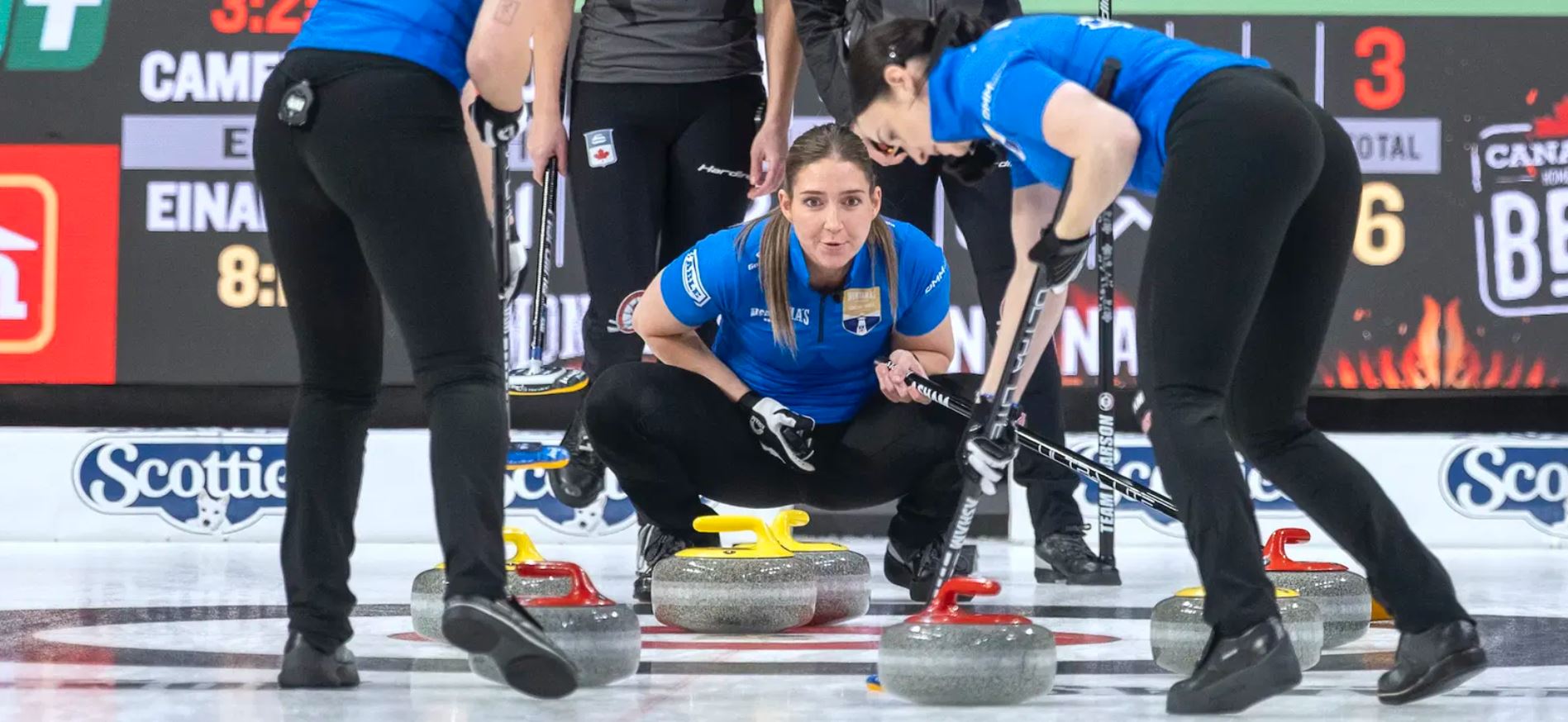
 Harris (crouching) vs Einarson in Halifax • Andrew Klaver-Curling Canada
Now for some of the reveals within the CAS report.
• The hearing was held on Aug. 23, 2024 in Switzerland in a virtual format, with Harris and her Canadian attorneys in Canada and World Curling – the claimant – in Scotland, accompanied by Swiss-based legal representation.
• Harris’ claim that she bore No Fault or Negligence for the ligandrol finding was backed by expert evidence from a “Professor Kintz” involving hair sample analysis from Harris (a negative test result) and her husband (positive). Harris’ DNA test results were verified by Professor Christine Keyser, a molecular biologist, who confirmed the accuracy of the DNA matching process.
• World Curling contested the credibility of Harris’ claim, including the evidence she presented and its chain of custody, saying Harris failed to exercise the utmost caution as required under Article 10.5 of World Curling’s Anti-Doping Rules (ADR).
• However, World Curling amended its position on the applicable sanction, suggesting the initial four-year suspension (“period of ineligibility”) could be reduced to 15 months starting from the date of the final CAS decision, with the provisional suspension period already served to be deducted.
• Both sides tried to use the Laurence Vincent-Lapointe (Canadian rowing) case to their advantage. Interestingly, sole arbitrator Patrice Brunet of Montreal ruled that decision – reached by the International Canoe Federation, not CAS – had never been made public (there were only media reports) and therefore could not be considered. However, Brunet noted that intimate contact as a source of contamination had been acknowledged in several previous CAS awards, including cases in 2009 and 2017.
• Harris addressed World Curling’s assertion that she should have been aware of the risks posed by her husband’s supplement use by pointing to Canada’s sport system. She argued her anti-doping training – the “True Sport Clean” program by the Canadian Centre for Ethics in Sport (CCES), now known as Sport Integrity Canada – did not contain any warning that prohibited substances could be transferred through bodily fluids. Harris further emphasized athletes can only take the utmost precautions against risks they are made aware of.
 Team Cameron at provincials • Curling Manitoba
“While on the face of it, the WCF’s position was reasonable and could have succeeded, this is an exceptional case, which ultimately turns on its facts, the credibility of its witnesses and what is the expected reasonable behaviour of an athlete in these unique circumstances,” wrote Brunet.
“In his analysis, the Sole Arbitrator has also carefully avoided to fall into the trap of painting a one-size-fits-all expectation of private matrimonial dynamics, which belong to the Athlete and her husband and cannot be reviewed under the principles of lex sportiva (law of sport).”
Team Cameron finished 1-6 at the Canadian Olympic Trials at the end of November, while Team Einarson lost the semifinal to Nova Scotia’s Christina Black.
Cameron placed third at the recent Manitoba provincial championship, while Einarson will represent Canada at the Scotties starting Jan. 23 in Mississauga, Ont.
About the Author